I’m a believer in the impact of great design. Countless times over the years, we’ve seen clients get better results when they improve their design. I’m drawn to brands with great design and a strong brand.
We see this with client websites on Rocketspark too. Sites designed by designers get more visitors, more calls and more form enquiries.
We use AI in a number of ways internally at Rocketspark. Some of them are a game changer and enable us to do better work. We’ve also found some use cases of AI lacking, tempting us to accept a lower standard of work in the pursuit of speed.
Initially the concern for designers was being replaced by AI that’s as good or better than them. The real concern now is that designers are being replaced by AI that in many situations is worse than what they’d do.
In this post, I look into some of the impacts that AI is having on designers and small businesses now, then look into the future of AI and design. This post is also a call to arms, encouraging creatives to get involved in shaping the future of AI in a way that doesn’t devalue design and creativity.
On average, it seems like small business DIY design is getting worse
A growing number of small businesses are choosing to ChatGPT their way to bad design. “Well hold on”, some might say. “Didn’t these businesses have bad design and branding before? Because they have small budgets?” In some cases yes, but at least it was authentic. When you walk past 5 cafe’s and they all have the same sweat droplets and tire skidmark design aesthetic, fake looking food and way too much text, we are looking at a bad design pandemic.
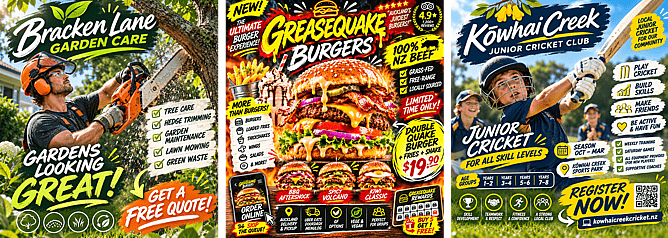
Comic Sans and Papyrus have been the laughing stock of fonts for a while but the brush stroke font overused by AI is now turning up everywhere. We mocked up this poster as a bit of a simulation of the kinds of design we’re seeing that’s now all too common.
If good design can help businesses stand out, win customers and grow, then access to good design is important. But with more small businesses opting to DIY their design with AI (and the risk that less students could see design as a viable career), great design could become more scarce.
Some businesses will improve their design with AI though. If the person driving it has good judgement, they can filter the good from the bad (even if they didn’t have the skills to produce it themselves without AI). This is represented in the dark blue band of the diagram below.
By contrast, imagine a business that does excellent work and earns strong referrals. Its new AI website is filled with fake-looking AI photos instead of real photos of its people and projects, vague language and a visual identity that feels generic. A potential customer arrives at the site but is put off and leaves, eroding the brand reputation they’d built. This is represented as the dark band on the diagram below.
While some businesses will be better off than they were before because of AI, on average it seems that DIY design has gotten worse.
Interactive diagram
Predicted impacts of AI design on small businesses
This diagram represents predicted impacts to small businesses as a whole, based on different levels of competency for deploying AI design and the quality of design that is going to market.
It steps through each path on its own. Hover over or tap any band to jump straight to it.
Before AI: Great brand and marketing
Even better with AI
Some businesses will improve their design with AI. If the person driving it has good judgement, they can filter the good from the bad (even if they didn’t have the skills to produce it themselves without AI).
Before AI: Great brand and marketing
Slipped to mediocre
Some businesses with a strong brand hand too much over to AI. The work still looks polished at a glance, but it loses the specific details and personality that made them stand out. They end up looking like everyone else.
Before AI: Mediocre marketing and design
Mediocre, faster
Plenty of businesses with average marketing stay average. AI helps them make more of it, faster, but it doesn’t add the judgement that was missing. More posts and pages, same results.
Before AI: Bad DIY marketing
Better with AI
Some DIY marketers will genuinely level up. AI gives them better copy, layouts and images than they could make on their own, and they have enough taste to keep the good bits and bin the rest.
Before AI: Mediocre marketing and design
Swapped designer for AI
These businesses used to work with a designer, then decided they could replace that service with AI. Without good design judgement, they’ll likely be worse off.
Before AI: Bad DIY marketing
Worse with AI
Imagine a business that does excellent work and earns strong referrals. Its new AI website is filled with fake-looking AI photos instead of real photos of its people and projects, vague language and a visual identity that feels generic. A potential customer arrives at the site but is put off and leaves, eroding the brand reputation they’d built.
Before AI: No marketing
Still no marketing
Some businesses carry on as before. They keep relying on word of mouth and don’t use AI for marketing at all, so nothing changes, for better or worse.
Before AI: No marketing
Worse than no marketing
These businesses only did word of mouth marketing before. Now they suddenly pump out brand damaging AI slop that’s worse than no marketing.
More marketing gets made. The average small business ends up worse off.
Looking back at our March 2025 predictions
In March 2025, I published a set of predictions about AI and graphic design. Looking back, some changes happened sooner than I expected. Despite that, the value of a creative human in the workflow is now more valuable than ever (whether AI is used or not).
Here’s an update on those predictions now, in October 2026.
| What we predicted | My updated view |
|---|---|
| 2026–27 — Co-design through instructions becomes standard. | This workflow is now possible. For example, Figma’s MCP server lets an AI agent create and edit real design content. Wider adoption of MCP tools is likely to embed itself more across 2026/27. |
| 2026–27 — AI assists with layout, composition and second opinions in real time. | Those kinds of assistance are available in supported workflows. The designer still needs to judge whether the advice or adjustment improves the work. A new problem is that designers' clients are putting designers' work into AI and asking it to critique the design, getting back 20 page documents they don’t read and passing on an AI slop grenade to the designer. Some designers are adding to their terms and conditions that clients can’t put their work into AI. |
| 2026–27 — Stock imagery improves in diversity and ethical representation. | By default, AI images are generic and reinforce stereotypes, but this can be prompted to be more diverse now. Even the most impressive AI images still feel hollow though, in a way that’s difficult to put your finger on. There is no replacement for a service business using real photos of their people and projects. |
| 2026–27 — Project management tools automate more design admin. | That capability is available now too. Various project management tools have AI connectors and automation capability. |
| 2028 — Generated designs rival human work in many cases. | I think what would be more accurate here is that generated designs are better than the work of weaker designers, but don’t come close to the best designers. |
| 2028 — Businesses get unique branding with minimal input. | Producing a brand identity with minimal input is possible now. ChatGPT Astra in particular has generated some impressive results. But what remains unanswered is how it came up with that visual and if you can truly own the copyright on that branding. Whose branding was it trained on? |
| 2028 — AI assists with broader strategic business tasks. | That is already part of how people use these tools: strategy discussions, dashboards, widgets and small custom apps. |
| 2028 — Designers become creative directors who curate AI output. | Some designers are working this way. My concern is whether their own point of view survives the process, or whether the work retains an AI feel despite their involvement. |
| 2030 — AI becomes integrated across industries. | For better or worse, I still expect AI usage to continue to increase. |
| 2030 — Most small businesses rely on AI branding and marketing. | This is starting to happen faster than expected, although we can’t yet say “Most” small businesses. My concern is that greater reliance could leave many of those businesses worse off. We are hearing from designers that clients are coming to them with poorly designed logos made with ChatGPT and asking them to convert them for print and signage usage. |
| 2030 — Fully automated business operations become feasible. | I’m less confident in this broad prediction. A collection of automated tasks is a long way from a business that consistently serves customers well, without people making key decisions. We are starting to learn that there is a secret sauce that comes with a human’s nuanced perspective, that AI often overlooks. |
| 2030 — Designers evolve into AI specialists. | I no longer see this as the defining future for the whole profession. Some will specialise in AI. Others may build their value around distinctive human creativity, with a range of choices about which tools they use. Just like not everyone eats at fast food restaurants because they’re faster and cheaper. |
The latest predictions for October 2026. A creative resistance movement is needed.
While we could be heading for some sort of Mad Max dystopian future where all designs look the same, my hope is that we see a sort of creative renaissance. Or maybe even a creative resistance movement.
We are already seeing this in the creative community with movements like “The only AI I use is Adobe Illustrator” posts and a push towards handmade from high-end brands. Many designers are speaking out about the technology that seeks to replace them. The tech was trained on their copyrighted work, only to produce work that isn’t as good as theirs.
I’ve noticed that friends with taste (who aren’t designers) are now able to identify AI slop design and are avoiding brands that use it.
In early 2026 I bought into the idea that AI is getting smarter exponentially and the best approach was to be ahead of the curve with AI. The get onboard or miss the boat mentality. Ten months on, I’m not buying it. I don’t want a future where design is worse. Art, human creativity and originality are an expression of what it feels like to be human. AI will never have that perspective.
Not everyone is a skilled creative or an artist though, which is why this threat is flying under the radar and felt most keenly by the creative community.
AI for creative work isn’t a tool, it’s outsourcing. If everyone is outsourcing everything creative to computers, we create a bleak future where no one is shaping the cultural zeitgeist in a way that influences future generations. Music, art, fashion, film, architecture, photography and design could all become more generic if we don’t prioritise creativity.
But, I don’t think AI is going away. I do believe we can and need to shape the version of AI we get though. Not only for our future, but for our kids and future generations. This might require creatives to get more noisy about the value and importance of human creativity and design. And not just directed towards other designers, but educating the wider community.
Knowing when not to use AI becomes a critical design skill
Obviously AI-generated design and photos are uncool right now. They are not in fashion. Uncool is bad for business.
Some of the best designers will use AI selectively to replace low creativity, repetitive work at scale, while retaining creative control of the most important aspects of design. For small businesses, these designers will offer a level of value and skill that the business owner could never reach using AI themselves. Give a power tool to a carpenter and to someone who has never built anything. Both can cut timber quickly. The carpenter knows where to cut, how the pieces should fit and what a great result looks like. Designers bring that kind of understanding to design.
AI connectors may become more widely used with design apps like Adobe
One use case for AI in design that’s emerging is AI connectors (also known as MCP or model context protocol).
Making an elaborate design is slow. I’m not talking about coming up with the ideas, I’m talking about adding the elements one by one, positioning them, adjusting colours, settings, fonts with a mouse.
AI connectors let you describe (by voice or typing) to Chat GPT or Claude the design that you want and the AI will go and build what you’ve asked for.
When Figma’s MCP came out it was slow and clunky. Now it’s fast and actually really helpful for speeding up the tedious steps of design. If you use voice dictation, it’s like a creative director describing the look they’re wanting and AI producing it based on the description.
Video editing with MCP, by connecting creative software with Claude or ChatGPT can speed up the process of processing raw video and turning it into a first draft of an edited video.
In November 2026, Adobe announced MCP connections for Photoshop, Illustrator, Premiere and After Effects coming in early 2027. They demonstrated the feature by controlling Adobe apps from Claude. While there’s been a Claude connector for Adobe for a while, you couldn’t actually edit design files on your computer with it and had to upload them for editing. This could see increased MCP adoption from graphic designers once it becomes available.
The flipside of this is that there’s been significant social media backlash from Adobe users who feel like Adobe is abandoning them and focussing on office workers rather than the creatives the brand was built on.
At its worst, an MCP enables bad design to be done by those without judgement accepting what the AI gives back. At it’s best you’re not outsourcing the brains of design to AI, just the driving of the interface. Conversational voice can be a little clunky at times but we could see a future where the interface of design isn’t mouse, stylus or keyboard, but conversational voice. The difference in result will still be the skill of the person driving.
Negative sentiment around AI photography will continue to increase
In a study by Getty Images with over 30,000 adults in 25 countries, they found that 98% of consumers believe “authentic images and videos are pivotal in establishing trust”. The research also found that AI-generated images of humans were viewed as more misleading than non-human subjects.
For a service business, AI photography instead of real people and projects is brand-damaging. Buyers are also becoming more vocal about AI generated food images. If it doesn’t represent a real thing, skepticism creeps in and it feels inauthentic.
We may see some sort of quality mark in future to represent real photography that hasn’t been generated or heavily edited with AI. If a business chooses not to use any AI images on their website, this quality mark could appear in the footer, like other trust indicators. Google SynthID already has the technology to detect if an image is AI generated and many online platforms now automatically label AI generated content.
It isn’t just about whether it looks bad or looks too AI either. Ultimately it’s about whether you can trust what you’re seeing. The EU has brought in new legislation around deepfakes that “resembles existing persons, objects, places, entities or events that would falsely appear to be a person to be authentic or truthful’.
Recently NZ brand Huffer was also in hot water in the news after being accused of publishing ads with AI likenesses of models who they’d previously paid to model their clothing lines.
Prominent podcaster Chris Williamson (4.5m subscribers) has called out AI voice company Eleven Labs for using a clone of his voice, which they’ve denied. But the resemblance is uncanny and they’ve since removed the voice.
While this instagram carousel by Shotby.rob is a lighthearted jab at AI edited images, the message is clear. Keep it real. Keep the photo in photography.
One business, Southland Roof Repairs created a hand drawn looking ad to tap into this sentiment. The post has had 134k reactions and 3.5k comments. But what’s fascinating is that there was speculation in the comments whether the hand drawn post had been created with AI, as there’s a range of other similar posts online.
What isn’t debated in the comments though is people being sick of the AI designed ad aesthetic, that’s a given.
Creative direction still needs a human point of view
Recently I explored the idea of AI taint. Let’s think about this with a cooking analogy. You’re doing a multi step cook and burn the ingredients at one step. If you don’t bin those ingredients at that step, you taint all future stages of the cook.
The temptation when AI delivers mediocre work at a step in a workflow is to settle. Settling for 80% because restarting or redoing it by hand would take a lot more time.
My prediction here is that distinctive human work could become more valuable. As generic-looking output becomes expected, a designer with something original to say could give a client a greater advantage to stand out.
The impact of AI on our creativity and cognitive ability may take decades to understand
What will be the cognitive, environmental and societal risks we haven’t fully anticipated with AI?
At Rocketspark, we’ve run a technical test for years as part of our software development internship induction. What we noticed this year is that less students were able to pass the test.
With AI technology being so new, it’s unclear what it will do to us long term. Governments took many years to realise the harm of cigarettes, asbestos (once considered a ‘wonder’ building material) and social media.
In 2026 a Los Angeles jury has found Meta and YouTube negligent in a landmark addiction trial, Meta agreed to pay up to $16.7 billion to settle with a coalition of US states, and a New Mexico judge ordered it to pay $25 billion for misleading users about privacy (Meta plans to appeal).
Governments are catching up around the world as well. Australia has banned social media for under-16s, Indonesia and Malaysia have followed, France has passed a ban for under-15s, the UK has announced one for under-16s, and a bill has been introduced here in New Zealand. UNESCO says 114 education systems around the world now ban or restrict phones in schools.
My children don’t have access to social media but are expected to use AI at middle school as part of their school projects. It comes as part of Canva and Google Workspace. Is having an art-bot going to starve the next generation from the creative friction that’s important for learning? Drawing pictures, colouring in, painting.
One study analysed 1000 high school math students in Turkey. Those with ChatGPT solved 48% more of the practice problems correctly, but they ultimately scored 17% worse on a test of the topic. Students said they did not think that ChatGPT caused them to learn less even though they had.
In one 666-person study, younger participants showed a higher dependence on AI tools and lower critical thinking scores compared to older participants.
Barbara Sahakian, a clinical neuropsychology professor at Cambridge University, explains that the best defence against cognitive decline is to keep our brains working by learning new things, reading and staying socially connected.
Neuroscientist Vivienne Ming also warns that AI could increase dementia cases in the future. She found that students using AI have brains that are “measureably less active than when they work without AI”. Ming argues that “We need ‘productive friction,’ the challenges that make life a little harder and thereby make us better,”. She makes the case that friction, wondering and exploration are important parts of cognitive development: “Without errors to drive learning, our brain’s reward circuits stop responding to mystery. We short-circuit the parts where wondering becomes exploration.”
Whose work was it trained on? The ethical dilemma
In order to be able to generate artwork, design, branding and illustration, huge amounts of creative work and books were fed into the AI models.
Sometimes people talk about concerns with AI being trained on copyrighted work as being about appearance. If you say “Use AI but just make it look like it wasn’t made with AI”. That logic is like buying a stolen car cheap and painting it to look different even though you knew it was stolen.
There is a spectrum of ethics here though. You could use AI as an interface to speed up design work you creative direct, trained on your own design system. Or at the less ethical end of the spectrum, you could upload screenshots of another designer's work and say “design it like this”.
AI companies are already in legal hot water. Anthropic is paying a record $1.5 billion to authors whose pirated books were used to train Claude, and music publishers are still suing. OpenAI is fighting the New York Times over copyright, and a family has taken it to court over the death of their teenage son. None of these cases answer what AI does to the way we think long term, but they show the rules are still being written, just like they were for social media.
A legal and regulatory reckoning is likely still to come for AI.
Great design could become rarer and more expensive
This is where the supply-and-demand concern comes in. If fewer people enter design, and fewer juniors get the chance to build real craft, experienced creative judgement could become harder to find.
Businesses that value that expertise would compete for a smaller pool of people. The best designers could charge more, putting their work further beyond the budgets of the small businesses that need it.
How much ‘okay’ do we need?
As AI enables us to pump out huge volumes of mediocre design work, at what point are lesser volumes of great design more valuable, and is it a case of discerning the right tool for each particular stage of a workflow. For example, this task is better for humans, this one AI can do. Rather than just forcing AI into every stage of a creative process.
But a hundred versions of an ordinary concept are still built around an ordinary concept. Increased output creates its own overhead. Someone needs to check the assets, review the wording and curate what makes it out into the world.
Designers can build the guardrails
Design systems will start becoming more of a priority for brand and web designers than just software designers.
A design system is a visual specification of how different brand assets should look and work together. Design systems help give AI models the clues they need to get closer to your brand look and feel. They may become the AI era equivalent to handing over Canva templates to your client. Where the client can’t afford to keep paying the designer in a retainer capacity.
This is one way designers will be able to steer the quality of client generated AI design after a project ends.
How will you steer the future of AI?
As AI design gets better, great human design that is obviously better will become scarcer, so could become more expensive. Businesses that can afford great design will have a significant advantage.
For our community, educating the wider business community on the value of design (and the harms of bad AI design) become important to protect design standards globally.
And we can keep checking ourselves whether the work is actually good. A quick result still needs our judgement.
I still believe AI can help designers do better work and make working life better. But getting that benefit to the average small business will take more than just handing everyone the tools.
I haven’t addressed the environmental concerns around AI in this post. Personally I do have concerns about the potential future scale of exponential data centre expansion, but I don’t hear enough conversations around the issues described above, so I’ve focussed on those topics with this post.
